
Exploring the Role of Puppetry in Toddler Language Development

Puppetry is not just a form of entertainment for children—it's a powerful tool for language development in toddlers. Through puppets, young children can explore new vocabulary, practice communication skills, and enhance their understanding of emotions and social cues.
Puppetry offers a playful, interactive environment that encourages creative expression, making it a valuable resource for fostering language skills in toddlers.
In this article, we’ll explore how puppetry supports toddler language development, highlighting its benefits and offering practical suggestions for incorporating puppetry into your child’s routine.
The Benefits of Puppetry for Language Development
Puppetry is an engaging, multisensory activity that can help toddlers develop language skills in a natural and enjoyable way. Here are several key ways in which puppetry contributes to language development:
1. Encourages Vocabulary Building
One of the most direct ways puppetry supports language development is by encouraging vocabulary building. Toddlers are constantly learning new words, and puppets offer an engaging way to introduce and reinforce vocabulary.
Puppets can act as “characters” in stories, and through conversation with these characters, toddlers are exposed to new words in context.
For example, when a parent uses a puppet to act out a scene from a story, they might introduce words related to emotions (e.g., happy, sad, excited) or actions (e.g., jump, run, sit).
As toddlers listen and interact, they begin to associate these words with their meanings, expanding their vocabulary in a fun and memorable way.
 2. Promotes Conversational Skills
 2. Promotes Conversational Skills
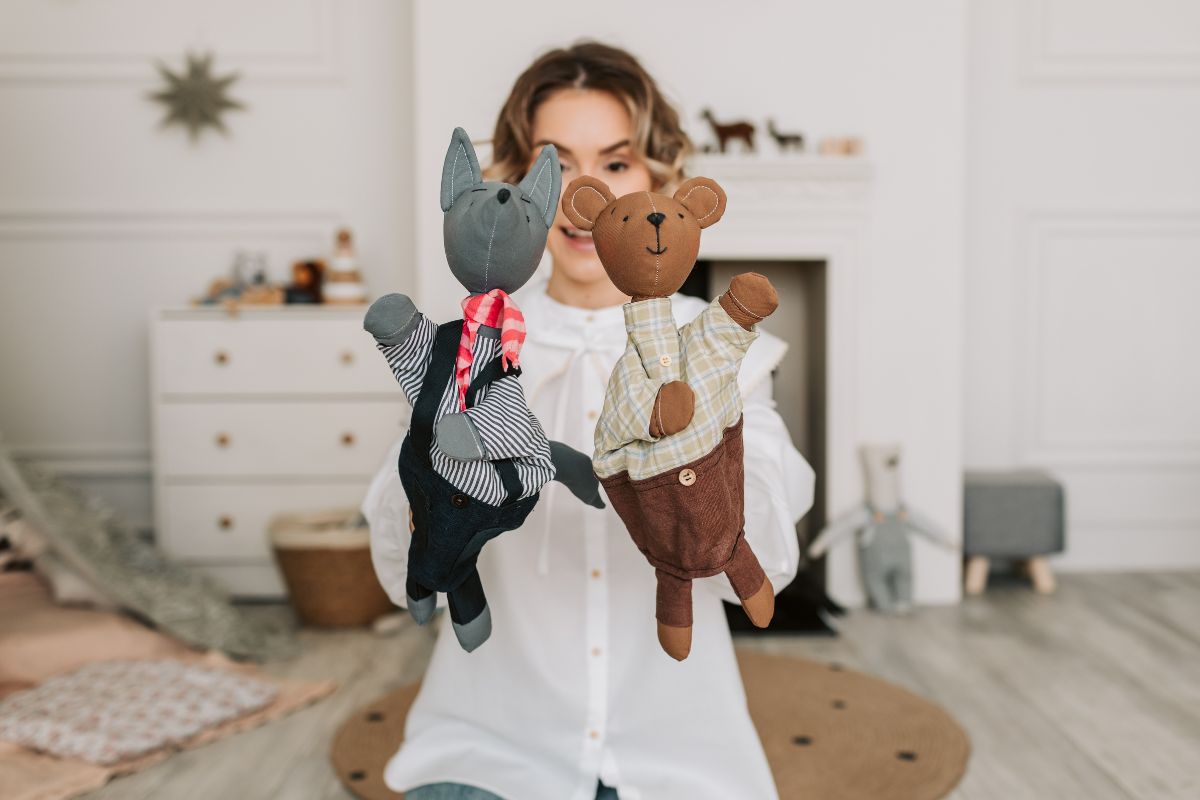
Puppets provide a great opportunity for toddlers to practice conversational skills. When children interact with puppets, they often engage in back-and-forth dialogue, practicing the structure of conversation—such as taking turns, listening, and responding.
This helps toddlers develop important skills like active listening, understanding the flow of dialogue, and using appropriate language in various contexts.
For example, a puppet can ask a toddler a question, prompting the child to respond. These interactions allow toddlers to practice their speech, refine their pronunciation, and develop an understanding of how conversations unfold. Over time, this practice can help them become more confident communicators.
3. Stimulates Imaginative Play
Puppetry encourages imaginative play, which is crucial for a toddler’s cognitive and language development. When children engage in puppet play, they step into the shoes of different characters and explore various scenarios, which stimulates their imagination.
This kind of role-playing allows toddlers to practice storytelling, using their imagination to create stories and dialogues that may not occur in their everyday lives.
This imaginative aspect also helps toddlers learn about the structure of language—how stories begin, develop, and end. As they take on different characters and roles, they start to experiment with different ways of speaking and expressing emotions, which can enrich their understanding of language.
4. Facilitates Emotional Expression and Understanding
 4. Facilitates Emotional Expression and Understanding
Puppetry is an effective tool for helping toddlers express and understand emotions. Puppets can be used to demonstrate a wide range of emotions—happy, sad, angry, excited, etc.—which helps toddlers identify and label their own feelings.
By watching puppet interactions, toddlers learn how emotions can be expressed verbally and non-verbally, such as through facial expressions, tone of voice, and body language.
For example, if a puppet expresses sadness because it lost a toy, toddlers can be encouraged to name the emotion and discuss how the puppet might feel better. This not only helps with emotional regulation but also enhances the child’s emotional vocabulary—the words they need to describe their own feelings.
How to Use Puppetry to Support Toddler Language Development
Now that we’ve explored the benefits of puppetry for language development, let’s look at some practical tips for incorporating puppetry into your toddler’s routine to support their language skills:
1. Read Books with Puppets
 1. Read Books with Puppets
Reading together is an excellent way to promote language development, and when you add puppets to the mix, it becomes even more engaging. Choose a storybook with characters and plot elements that can easily be represented by puppets.
As you read, use the puppets to act out parts of the story, helping your toddler visualize the action and interact with the text.
For example, if you're reading a book about a dog and a cat, you can use a dog puppet and a cat puppet to bring the characters to life. As you read, let the puppets "speak" the dialogue, encouraging your toddler to join in the fun by mimicking the puppet's speech or actions.
2. Create Puppet Shows Together
Encourage your toddler to take an active role in puppet play by helping them create their own puppet shows. You can make simple puppets using socks, paper bags, or even your hands.
Once you have your puppets, set up a mini stage (this could be as simple as a table or a blanket) and work with your toddler to create a story.
Start by discussing the plot and characters, asking your toddler to come up with ideas for what the puppets will do or say. This process helps toddlers with storytelling, and by playing the role of different characters, they practice language structure and communication.
3. Use Puppets to Practice Everyday Situations
 3. Use Puppets to Practice Everyday Situations
Puppets can be used to practice everyday language skills in a fun way. For example, if you’re teaching your toddler about manners, use a puppet to model polite behavior, such as saying “please” and “thank you.”
Puppets can also be used to practice asking and answering questions, making requests, or even talking about routines like brushing teeth or putting on shoes.
By modeling these situations with puppets, you’re helping your toddler understand how language works in practical settings. You can even create little "scripts" that involve basic phrases and questions your toddler can repeat after the puppet, further reinforcing language learning.
4. Encourage Expressive Language
In addition to helping with vocabulary and conversational skills, puppetry encourages toddlers to use expressive language. Puppets can be used to explore descriptive language (e.g., “The red ball is bouncy!”) and action words (e.g., “Jumping! Running!”).
As you play with puppets, encourage your toddler to use words to describe what’s happening in the puppet show, enhancing their ability to communicate clearly and vividly.
Puppetry as a Powerful Language Tool for Toddlers
Puppetry offers a unique and fun way to support toddler language development. By encouraging vocabulary building, conversational skills, imaginative play, and emotional expression, puppets provide a rich, interactive experience that engages toddlers and promotes language learning.
Whether you are reading stories with puppets, creating puppet shows, or practicing everyday language, puppetry fosters a love for communication and helps toddlers develop the language skills they need for future success.
Through playful interaction and creative expression, puppetry becomes more than just entertainment—it becomes a powerful tool for growth and learning.
By making puppetry a regular part of your toddler’s routine, you are giving them a fun and effective way to explore language, develop social-emotional skills, and build a strong foundation for lifelong learning.
Did you find this post useful or inspiring? Save THIS PIN to your PARENTING Board on Pinterest! 😊


You may also like